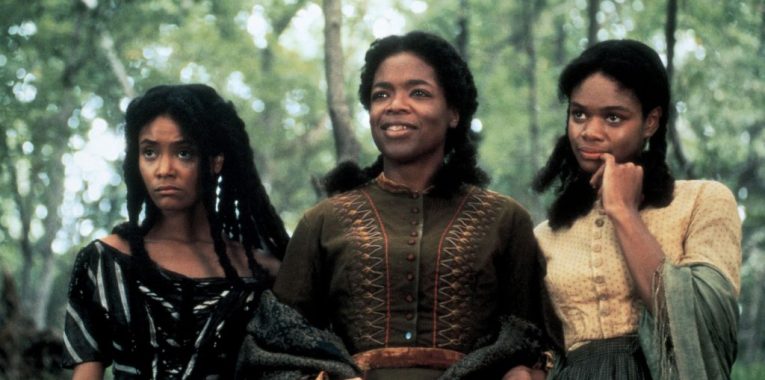
Beloved, written by the late Toni Morrison, tells the story of a fugitive slave named, Sethe. Sethe attempts to kill each of her children in order to prevent their enslavement. She successfully kills one, Beloved, who the novel is written after. Beloved’s ghost manifests as a fully-grown woman who haunts Sethe and her daughter in their home, 124.
I must admit, this novel was difficult to read. Not just because of Morrison’s colorful language, but because of the sheer heaviness of the text. Sethe kills her daughter. Her own flesh and blood. The graphicness of that is almost unbearable. Imagine, “what it took to drag the teeth of that saw under the little chin,” as Morrison writes.
In its intensity, Beloved provides two major takeaways. Firstly, Sethe’s action shows a resiliency that humanizes her. She is neither beast nor animal. She is a mother who has a “compulsion to nurture,” even when the situation does not appear conducive to do so. Secondly, slaves, though often dehumanized, were actual people. Complex beings with emotions, feelings and dreams. This is an important lens through which to understand slavery. Morrison does an excellent job of illustrating that slavery was not just a collective experience but was also an individual one that affected each affected each person differently.
Sethe is humanized by dispelling the paradigm that she exists in, the one that subjects her to the white man, the one that emboldens the idea that she owns nothing. There is an element of power that exists when a person takes it, though it is not granted to them. Sethe does just that. She owns nothing. She does not own her daughter. She does not own her life. She is, biologically, a human-being, but is reduced to a slave, therefore an animal of the wild, and animals do not choose. Yet, her power is evident when she takes a right that is not hers to begin with. In deciding to kill her daughter, she simultaneously exposes the fault of this hierarchy: She is a person. She has love, anger, sadness—actual emotions that exist. She forces her oppressors to recognize her and despite her gruesome action, in making this decision, she takes the power away from those who suppress her ability to choose.
Morrison also humanizes slaves in this text by demonstrating that they are individuals. They are unique people with their own idiosyncrasies. They should not just be thought of as a group of people subject to slavery, because each person’s experience is different. Thus, to truly understand Beloved and appreciate (yes, appreciate!) Sethe’s decision to kill her daughter, you have to step into the shoes of the characters.
Ladies, imagine this: You are forced to carry child. You carry this child for months. Your feet are swollen. You find difficulty getting out of bed or even putting on your shoes. You continue to work long hours for no pay, other than the prospect of breathing for another day because no day is guaranteed. For whatever reason, you may be slaughtered if you are deemed “unsuitable.” The father; no not father, but man who impregnated you, works long hours and cannot support you through this process. You are approaching your delivery date. The days feel longer; you feel heavier. You continue to work from sun up to sun down, caring for your mistress while neglecting your own health, let alone the health of your unborn child. You are without options.
Men, imagine this: You are beaten when you speak when you are not spoken to. You believe that you are giving your master suggestions, but he calls it “back-talk.” You have stripes on your back and bruises on your wrists. The rope burn on your neck has turned your black skin pink, then a violent red and now purple. You are not a man. You are likened unto cattle. You labor, you shit, you sleep, you arise and you labor once more. This perpetual cycle should leave you no opportunity to think of life beyond the plantation, but something burning within you causes you to sing songs that tell stories of a land away from there. You labor. You endeavor to live by the rules in anticipation of a life. You do not know what that looks like, but you can imagine that it means better days, for your mother and your pregnant lover. You toil the ground. You carry the burdens. You do not think there will be a life for you, but maybe there is one for them.
What readers should capture from Beloved is the complexity of those enslaved. After reading this text, one is able to look at slavery through a new lens. Through the eyes of an individual. Suddenly, it is easier to understand slavery, not as just an injustice that happened to a group of 600,000 people (in the United States), but happened to individuals. People with their own predilections and personalities. This happened to mothers, fathers, daughters and sons. To people who, just like us, had dreams and fears. To people who, just like us, had loved ones. This, I believe, is an excellent framework for understanding slavery, especially for anyone who minimizes the impact of it. Stop thinking about slavery as just a massive event that happened to thousands of people. Look at it as an injustice that could have happened to any person in your family, because this happened to people—individual people who actually exist.
For more content on great reads, business / finance, service and faith, connect with me on all social platforms @dernyfleurima.
 Derny Fleurima